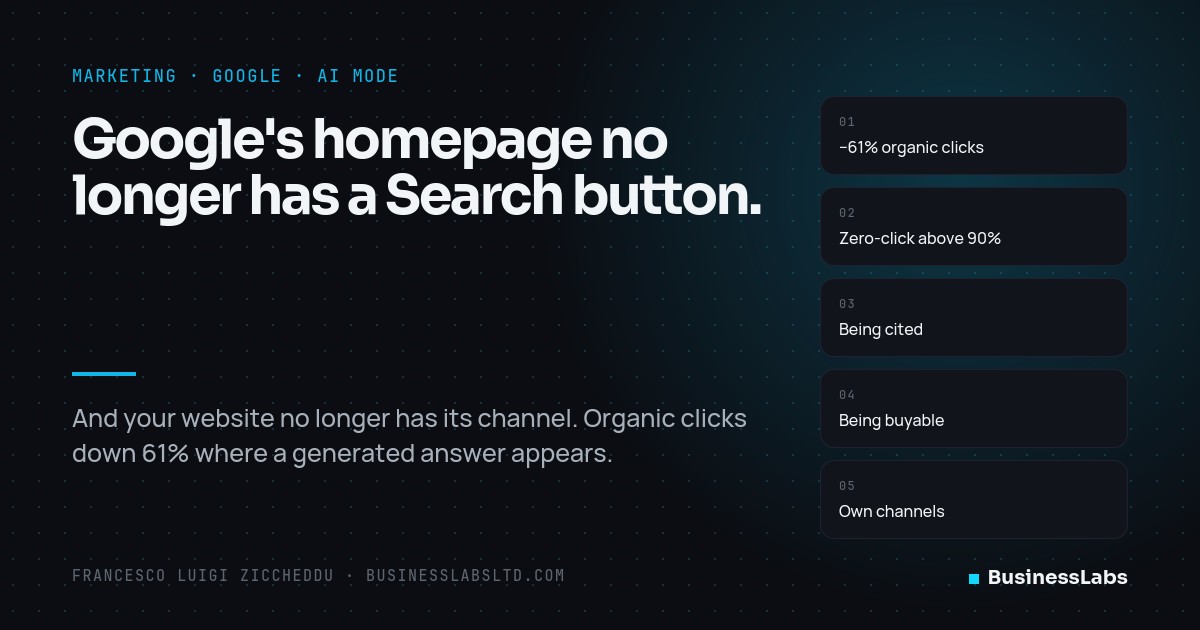
In place of "Google Search" there are "Create images", "Ask about files" and "Brainstorm", with AI Mode in the bar. Google calls it a test. For anyone selling online it is the end of a model that lasted twenty years, and the numbers already say so.
Since August, Google has been showing a growing share of users, first in the United States and now in Italy too, a homepage different from the one we have known since 1998. The search box is still there, but underneath there is no longer a "Google Search" button. There are three shortcuts: create images, ask about a file, brainstorm. Inside the bar, next to voice and Lens, sits the AI Mode button. Robby Stein, Google's vice president of product for Search, described it as a small desktop test that does not change how the box works: you type and press Enter, as always. That is true, and it is not the point. The point is that the most visited page in the world no longer invites you to search. It invites you to ask.
In a comment under a colleague's post, Alessandro Caprai wrote the most precise sentence I have read on the subject: more than a rebranding, it is a change in the paradigm of use, and the real theme for marketers becomes how to be cited inside the answers, because traffic from the ten blue links is bound to shrink further. I want to take that sentence seriously and follow it all the way, from the seller's side.
The model that is ending
For twenty years the model of a company selling online was linear and almost free in its logic: the customer searches on Google, Google shows ten links, the customer clicks, lands on the site, buys or leaves a contact. The entire industry we call SEO was born to win that click. Whole marketing departments, agencies, software products and careers are built on the idea that organic traffic is the raw material and the website is where it turns into revenue.
That model began to break with AI Overviews, the generated answers Google places above results, and breaks completely with AI Mode, where the answer is the whole page and links are footnotes. The data is now public and all points the same way. Seer Interactive, across 5.47 million queries tracked from January 2025 to February 2026, measures an organic click-through rate falling from 1.76% to 0.61% when an AI Overview appears: minus 61%. Pew Research, with a panel of real users, finds that people click an organic result 8% of the time when a generated answer is present, against 15% when it is not. A controlled experiment published this year measures a 38% drop in outbound clicks and a rise in zero-click searches from 54% to 72%. In AI Mode the share of searches ending without any click exceeds, by available estimates, 90%.
These are not the numbers of one bad quarter. They describe a new behaviour: the person gets the answer, finds it sufficient, and goes nowhere. The controlled study adds a detail that hurts: user satisfaction does not change. Traffic is taken from websites without the customer missing it.
Why sellers are less affected, for now
There is partial good news, and honesty requires saying it. AI Overviews appear mostly on informational searches, where a person wants to understand, compare, learn. On transactional searches, where a person has decided what to buy and is looking for where, the generated answer appears in a minority of cases, around 4% according to industry analyses, against 40–50% for informational ones. Anyone selling a specific product to someone already searching for it by name still sees the click arrive.
The problem is that an e-commerce business's value does not sit there. It sits in the moment before, when the customer has not yet decided: the buying guide, the comparison between models, the "which is best for", the "how to choose". That is the traffic that builds the relationship, fills the funnel, feeds remarketing. And it is exactly the traffic the generated answers are absorbing. For a retailer this means the top of the funnel, which Google supplied almost for free for twenty years, is being internalised by Google itself. The customer reaches you, if at all, already decided. Or does not reach you, because the answer told them where to buy, and that where is often a marketplace.
Where the game moves
The first thing to understand is that there is no going back. The homepage Google calls a test is the direction, not an experiment: Google has a competitor called ChatGPT, has lost searches on Safari for the first time, and is turning search into conversation because that is where attention is going. The dual track between classic results and AI Mode will last as long as it takes not to frighten advertisers.
The game moves to three grounds, and they must be held together.
The first is becoming the cited source. When the generated answer talks about a product or a category, it cites a few sources. Those cited gain: Seer's data shows brands cited inside an AI Overview earn 35% more organic clicks than those not cited, for the same search. Getting there takes concrete, unglamorous things: complete and consistent product pages across every channel, correct structured data, content that answers a buying question from start to finish, real and verifiable reviews, a brand Google recognises as authoritative in its category. That is not SEO. It is order in the data and seriousness in the content.
The second is being present where the agent buys. The next step of AI Mode is already announced: the answer that not only recommends what to buy but buys it. Google will do it through Merchant Center and product feeds, Amazon and the other marketplaces will do it inside their own assistants. Anyone without a clean feed, aligned prices and real-time availability across all channels does not enter the answer, whatever the quality of their website. Here the work is infrastructure, not content: one catalogue, one stock, one system keeping the channels aligned.
The third is building the channels Google does not mediate. Customers who return because they know you, not because they found you. A CRM that works, a newsletter people open, a loyalty programme worth joining, physical stores customers walk into. It is the slowest and least measurable work, and the only one that does not depend on what Google decides to show next year. One figure helps to remember it: visitors who arrive after reading a generated answer convert better and stay longer, because they arrive informed. Less traffic, but better, rewards whoever has something of their own to offer when the customer arrives.
What to do now
Three things, in order. First, measure. Open Search Console, compare impressions and clicks over the last twelve months: if impressions rise and clicks fall, you are already losing to generated answers, and you know on which pages. Second, put product data in order before any other initiative: pages, attributes, feeds, prices, availability, identical everywhere. It is the condition for being cited and for being buyable by an agent, and in my experience it is the weak point of nine companies out of ten. Third, decide what share of revenue you want to come from channels that do not depend on a platform, and build the plan to get there in two years.
Google's homepage has lost a button. Anyone selling online is losing a channel, and will replace it only with work that does not show: data, infrastructure, relationship. Those who wait to see how it goes will find themselves with a website and no visitors.
Sources
- Search Engine Roundtable and Futurism, August–September 2026: new Google homepage with "Create images", "Ask about files", "Brainstorm"; Robby Stein's statement.
- Search Engine Watch and Android Headlines, August 2026: test for signed-out users, AI Mode in the bar.
- Seer Interactive, study January 2025–February 2026 on 5.47 million queries: organic CTR from 1.76% to 0.61% with AI Overview; cited brands earn 35% more organic clicks.
- Pew Research Center, panel study: organic clicks 8% with AI Overview versus 15% without.
- Search Engine Journal, controlled experiment 2026: outbound clicks down 38%, zero-click from 54% to 72%, satisfaction unchanged.
- Industry analyses 2026 (Relevant Audience, Velacore): zero-click in AI Mode above 90%; AI Overview on about 4% of transactional queries versus 40–50% of informational ones.

CEO & Co-Founder of BusinessLabs. I have attended major international trade shows since 2015 and share here experiences and insights for online sellers.
LinkedIn