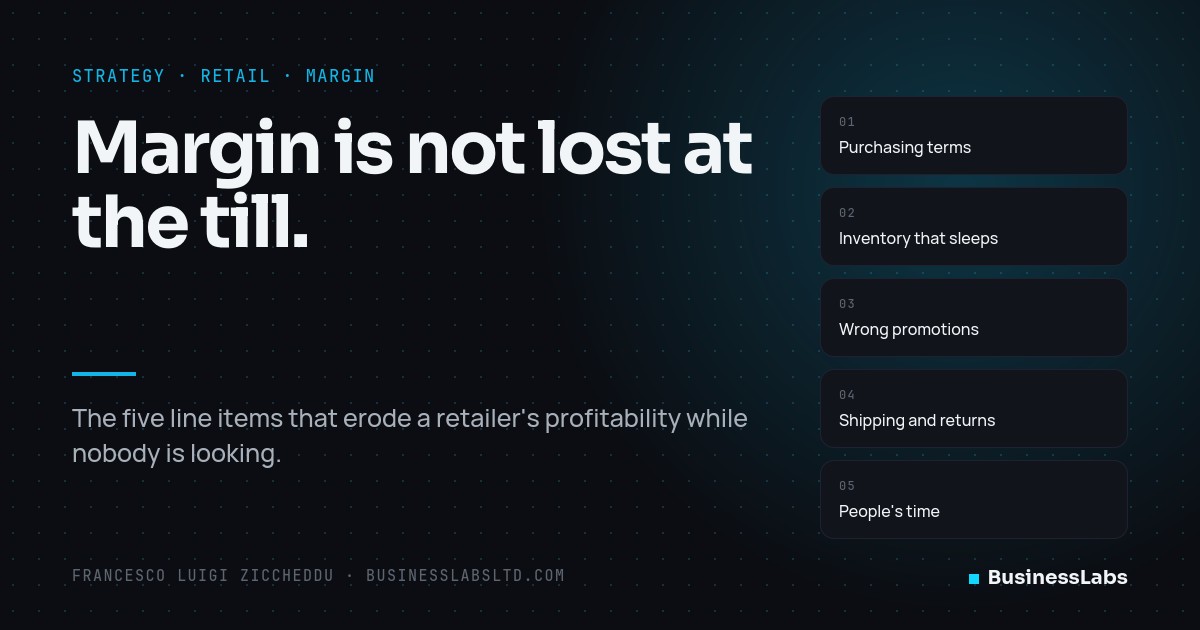
Purchasing, inventory, promotions, returns and people's time: where a retailer loses 3% to 6% of revenue every year, with the numbers and a table to fill in.
I spent eight years buying for a retail group and another eight running one. In all that time I watched the same scene repeat itself with almost comic regularity: revenue grows, everyone celebrates, and at year end the margin is the same as the year before. Sometimes lower. The explanation that circulates inside the company is always the same: competition, prices, the market. The real explanation, almost every time, is that the margin was not lost at the till. It was lost earlier, in five different places, and nobody was looking at all five together.
This article is about looking at them together. It is not a list of tips. It is the way I learned, as a general manager, to read a company that sells, and the way I still read our clients at BusinessLabs before we talk about channels, marketplaces or software.
1. Purchasing terms nobody renegotiates
The first place margin goes missing is the supplier price list. Not the price itself, but everything around it: volume discounts never reached, year-end rebates tied to unrealistic targets, payment terms accepted three years ago and never revisited, returns that were never written into the contract.
When I was buying for a retail group I had one rule: every supplier above 3% of total purchases gets renegotiated every twelve months, with last year's real numbers on the table. Not to squeeze the supplier, but because the terms we signed when we were doing 800,000 euros with them make no sense once we are doing two million. Most companies I meet do not have this rule. They have a buyer, a price list, and a renegotiation that happens only when something goes wrong.
What it is worth: on 10 million in revenue with a 60% cost of goods, one extra point of average purchase discount is 60,000 euros of gross margin. One point.
2. Inventory that sleeps
The second item is the most expensive and the least visible, because on the balance sheet stock is an asset. It sits in the right column. But idle stock costs money every day: tied-up capital, space, insurance, handling, obsolescence, and the final markdowns needed to get rid of it. Supply chain literature puts inventory carrying cost at 20% to 30% of average stock value per year. Take the low end: 20%.
A retailer with one million euros of average inventory pays 200,000 euros a year to hold it. If 300,000 of that million is made of SKUs turning less than once a year, the company is paying 60,000 euros to store products it does not sell. And those products will end up on clearance, taking another slice of margin with them.
The question to ask is not "how much stock do I have", but "how much of my stock turns less than twice a year, and what does it cost me to keep it". In my experience, those who ask that question for the first time discover that 20% to 35% of their warehouse should not exist.
3. Promotions that promote the wrong product
The third item is how promotions get decided. In most retail companies a promotion comes from one of three places: the supplier proposing it, the commercial calendar, or the intuition of whoever runs the store or the website. None of the three starts from margin.
The result is that the product already selling gets discounted to zero margin, to attract customers who would have bought anyway. Or a promotion is used to clear stock, late, at twice the discount that would have been enough three months earlier.
A promotion should be judged on one number: incremental margin. How much more margin it generated compared with not running it at all, counting the customers who would have paid full price. If the company cannot calculate that, every promotion is a bet. And in retail, bets are lost more often than they are won.
4. Shipping and returns: the margin that leaves after the sale
The fourth item concerns anyone selling online, but it also touches physical retailers with home delivery. The margin on an online sale is not closed when the customer pays. It is closed when the parcel has arrived, the customer has kept it, and the cost of shipping, packaging and handling has been deducted.
Return rates in European e-commerce vary widely by category: in apparel they sit around 25-30% of orders, in electronics between 8% and 15%. A return costs two shipments, a quality check, a restock and, often, a product that will never sell at full price again.
A simple calculation. Average order 80 euros, gross margin 40%, so 32 euros. Outbound shipping 6 euros, packaging 1 euro: margin drops to 25. With a 15% return rate, every order carries the average cost of 0.15 returns, each worth at least 12 euros in reverse logistics and write-down: another 1.80 euros. Real margin: 23 euros, not 32. Twenty-eight percent of the margin the company thought it had disappeared after the sale. And it stays invisible until you calculate it per order.
5. People's time
The last item is the hardest to see because it appears in no report. It is the time people inside the company spend on activities that create no value: reconciling orders between systems that do not talk to each other, copying price lists, checking availability by hand, answering questions a system should answer on its own.
When I ran a company of fifty people I did a brutal exercise: for two weeks I asked every manager to note how much of their team's time went into this kind of work. The result was between 15% and 25% of hours worked, depending on the department. With a payroll of two million euros, that is 300,000 to 500,000 euros a year spent compensating for systems that do not work together.
This is why BusinessLabs builds software today. Not because software is interesting in itself, but because the fifth item cannot be fixed with a meeting.
What to do tomorrow morning
You do not need a project. You need a table with five rows and two columns: the item, and what it is worth in your company. Real average purchase discount versus contractual. Value of stock turning less than twice a year, multiplied by 0.2. Incremental margin of your last three promotions. Real margin per online order after shipping and returns. Team hours spent on reconciliations and manual checks, multiplied by hourly cost.
If you can fill the five rows, you are looking at the amount you lose every year before you ever reach the till. In my experience it is between 3% and 6% of revenue. If you cannot fill them, you have discovered something even more useful: your first problem is not margin, it is that you do not have the numbers to see it.
Either way, that is where to start.
Sources
- Inventory carrying cost at 20-30% of average annual inventory value: APICS/ASCM industry benchmark, widely cited in supply chain management literature.
- E-commerce return rates by category: Statista, "E-commerce returns in Europe" (2025); NRF, "Retail Returns Landscape" (2025).

CEO & Co-Founder of BusinessLabs. I have attended major international trade shows since 2015 and share here experiences and insights for online sellers.
LinkedIn