The customer has chosen the product, put it in the basket, clicked "Proceed to checkout". Then they close the page. For many eCommerce businesses this is where the most revenue is lost, and hardly anyone looks at it with the same attention they give to campaigns.
The problem in one number
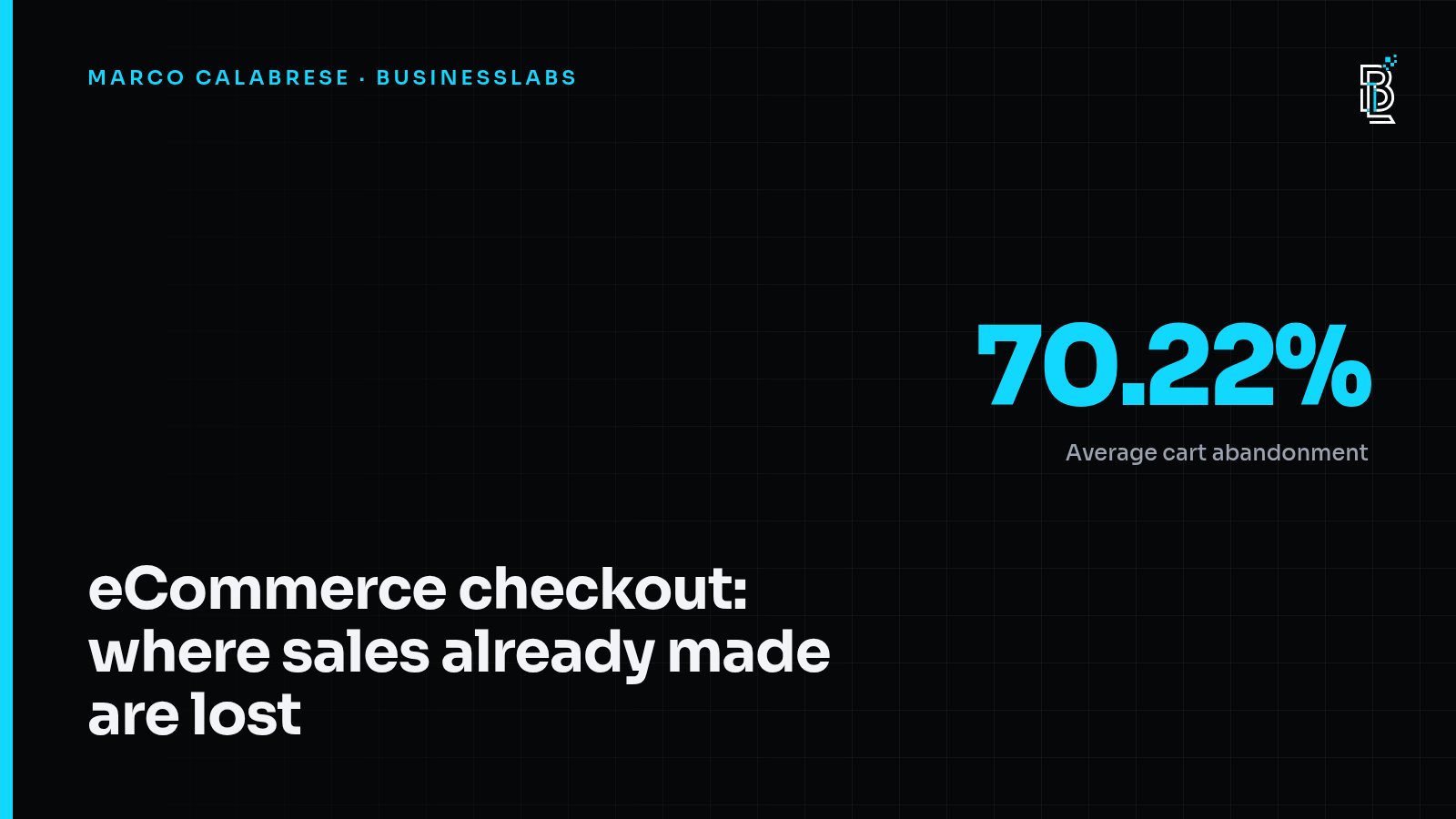
The Baymard Institute, which has been studying checkout usability for years, calculates an average cart abandonment rate of 70.22%, combining dozens of different studies. Part of that abandonment is natural: many people add to the basket only to compare or put off the decision. But another part depends on how the checkout is built, and that can be corrected.
In their 2026 survey of US online shoppers, among those who abandoned for reasons other than "I was just browsing", the most cited causes are:
- extra costs too high, such as shipping (40%)
- delivery too slow (20%)
- not enough trust in the site to enter card details (19%)
- being required to create an account (18%)
- checkout too long or complicated (17%)
- website errors or crashes (17%)
These are American figures, but in the Italian checkouts we analyse we find the same patterns.
Surprise costs: the number one cause
When the shipping cost appears only at the last step, the customer experiences it as a price increase. The price they had in mind was a different one.
What we usually do:
- show the shipping cost already on the product page or in the basket, even just as an estimate by country
- clearly state the free-shipping threshold and how much is missing to reach it
- avoid items added at the last moment, such as handling surcharges or cash-on-delivery fees not declared earlier
According to Baymard, 12% of those who abandon do so because they cannot see the order total in advance. It is the same problem seen from another angle.
Mandatory accounts and unnecessary fields
Asking people to register before paying is a barrier that can be removed in an afternoon. Guest checkout should always be there, and account creation can be offered after the purchase, with the details already filled in.
The same goes for forms. Baymard finds that an average checkout in the United States shows almost 15 fields, while a well-designed flow can stop at 7 or 8. Every extra field (second address, email confirmation, phone number required for no reason) is an opportunity to stop.
Trust and payment methods
19% of those who abandon do not trust the site when it comes to entering their card. Details matter here: certificates and card-scheme logos visible near the payment field, a design consistent with the rest of the site, no sudden redirects to pages that look different.
Then there is the choice of methods. 9% abandon because they cannot find the method they use. An Italian customer expects to find at least cards, PayPal and a digital wallet such as Apple Pay or Google Pay. If you sell abroad, the right method changes from country to country.
How to measure before you change anything
Before redoing the checkout, it is worth understanding where it breaks down. Analytics tools let you build a step-by-step funnel: basket, shipping details, delivery method, payment, confirmation. The step with the sharpest drop is the one to fix first.
Two checks we always recommend:
- place a test order from a smartphone, on a slow connection, timing how long it takes
- compare the completion rate between mobile and desktop: if mobile is much lower, the problem is almost always the interface
Where to start
You do not need to redo everything. In BusinessLabs projects the checkout is part of the 90-day plan together with the rest of the shop: first you measure, then you work on the two or three points that lose the most, then you measure again. Shipping costs shown earlier, guest checkout, fewer fields and the right payment methods are often the changes that weigh most for the same traffic.
The cheapest sales to recover are those from people who had already decided to buy.
Further reading: Marketing service · Payments service · Email marketing: the four automated flows
Originally published on LinkedIn

Co-founder of BusinessLabs since 2023, he leads the marketplace area: strategy, launch and growth of Amazon accounts and expansion into foreign markets, from Europe to the Emirates and South America.
LinkedIn