Every year, between late October and mid-November, we get the same call: "Shall we put everything on offer for Black Friday?". The right question is a different one: which products, with which tool and at what minimum price. On Amazon a badly planned promotion doesn't just fail to sell. It can wipe out a whole quarter's margin or, worse, cause problems with your reference price in the months that follow.
This year Black Friday falls on Friday 27 November and the week of deals closes with Cyber Monday on the 30th. Here is how we set it up with our clients.
The calendar that matters is Amazon's, not the client's
Deals for peak events are submitted weeks in advance. In the 2026 peak season calendar that Amazon published on the Seller Central forums, the deadline to submit promotions for Black Friday Week is 18 November, while sellers who submitted by 5 September received a 30% discount on the fixed fee. Stock has a deadline too: to show the Prime badge during the event, FBA inventory had to reach the fulfilment centres by 21 October.
In practice, anyone deciding now is working with the stock already in the warehouse. So before choosing discounts, we look at the days of cover for each ASIN. A product that sells out on 28 November loses ranking in exactly the December weeks when sales stay high.
Deals, coupons and Prime discounts: three different tools
They are not interchangeable and they don't cost the same.
- Deals: they appear on the event pages and get the most visibility. On Amazon.it, during peak events, the fee is €10 fixed per deal plus 0.5% of promotional sales, capped at €300. Amazon sets the maximum deal price based on price history: if yours is higher, the deal is excluded.
- Coupons: they stay on the product page and in search results. Since November 2025 in Europe they carry a €2 fixed fee and a 0.5% variable fee, with a cap of €100 per coupon created after the fee change.
- Prime exclusive discounts: they show the struck-through price only to Prime members and require a minimum product rating of 3.5 stars.
For hero products with good reviews we use a deal. For the rest of the catalogue a well-judged coupon is often enough: it costs less and doesn't force you below the threshold Amazon sets.
The starting price matters more than the discount
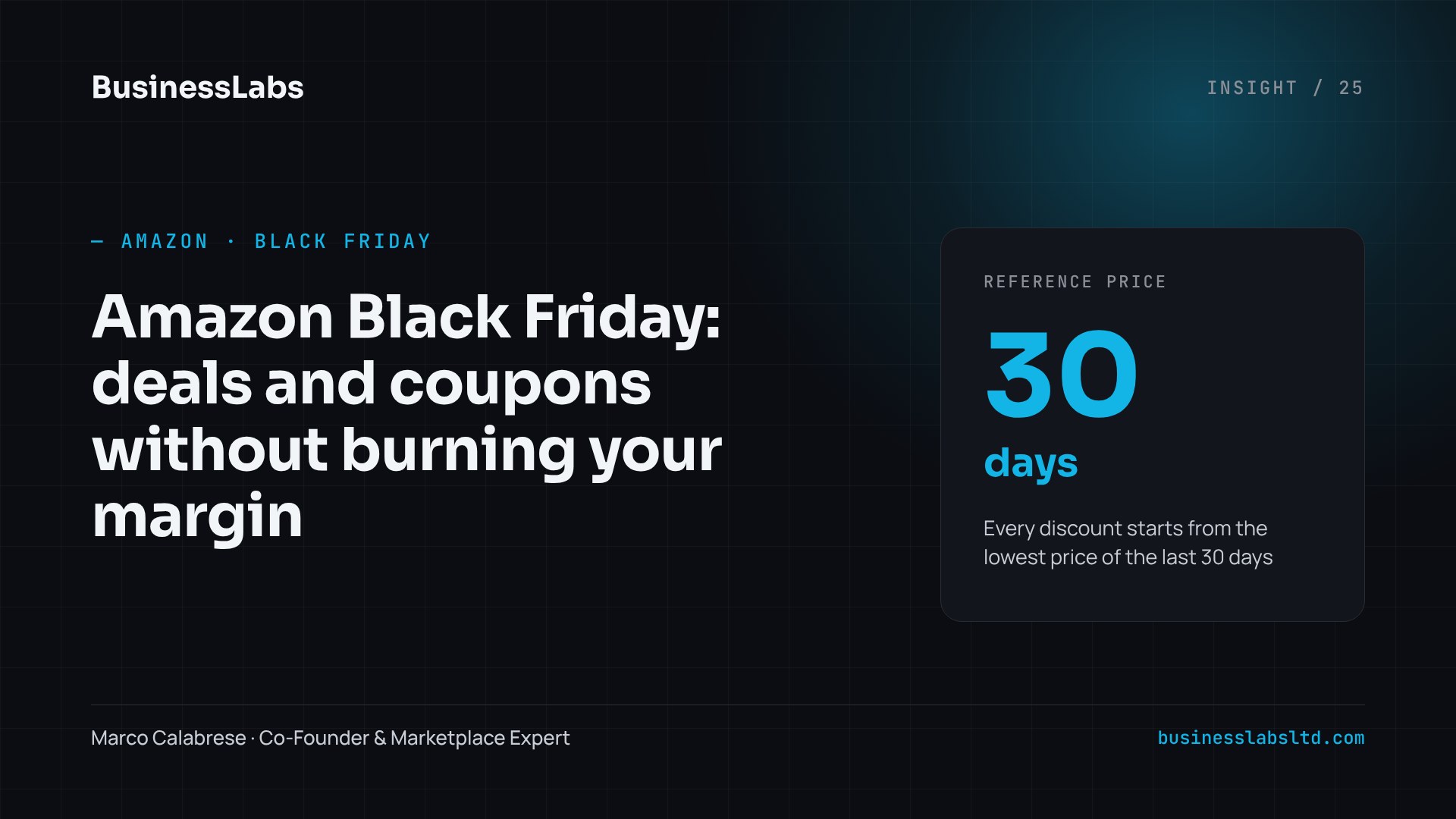
In Italy, Article 17-bis of the Consumer Code, in force since 1 July 2023 following the transposition of the Omnibus Directive, requires every price reduction announcement to show as the previous price the lowest price applied in the 30 days before the discount. Raising the list price in early November and then "discounting" it doesn't work: it is an unfair practice and the penalties can be heavy.
On Amazon there is also a practical effect. A deep discount lowers the reference price the platform will use to assess your future deals. If you cut by 40% in November, a 15% discount in January may not be enough to get a new deal.
The sum to do before submitting an ASIN
For each product we calculate the margin at the promotional price, not at the full price:
- deal price, excluding VAT;
- minus the referral fee and the FBA fee;
- minus product cost and freight to the warehouse;
- minus the share of the deal or coupon fee divided by the expected units;
- minus the extra advertising you will run during the event.
If the result is negative, the promotion only makes sense with a precise goal: clearing slow-moving stock or launching a product that needs to build sales and reviews. In every other case it is a cost.
Advertising and stock during the week
During the event CPCs rise, because everyone is pushing. Before it starts we raise the budgets of campaigns on the products on offer, so they don't stop halfway through the day, and leave the rest of the catalogue almost unchanged. Every morning we check three things: exhausted budgets, remaining stock and the actual price shown on the page, because coupons and deals on the same ASIN can stack and push the final price below what you planned.
What to do this week
If you haven't planned anything yet, there is still a lot you can do:
- choose 3-5 ASINs with enough stock to last at least until mid-December;
- check in Seller Central which ones are eligible for deals and at what maximum price;
- for the others, set up coupons with a discount your margin can carry;
- set a cap on advertising spend for the event days.
In our team this work is led by the project's single point of contact together with whoever manages the campaigns, supported by data from Selleee. The goal is not to sell more in one week, but to come out of Black Friday with margin, ranking and a reference price that is still healthy for January.
Further reading: Amazon account management · Multichannel pricing strategy · Buy Box and repricing
Originally published on LinkedIn

Co-founder of BusinessLabs since 2023, he leads the marketplace area: strategy, launch and growth of Amazon accounts and expansion into foreign markets, from Europe to the Emirates and South America.
LinkedIn