Almost every week a client suggests the same idea: "Let's put two or three products together and make a kit". On paper it is simple: a higher average order value and less direct comparison with sellers offering the individual item. In practice, an Amazon bundle only works if it follows precise rules, and those rules are changing.
Bundles, multipacks and kits: they are not the same thing
The first mistake is confusing the terms. For Amazon:
- Multipack: several units of the same product sold together (for example, a pack of 3 of the same detergent).
- Bundle: different but complementary products sold as a single offer with their own ASIN and identification code, different from those of the individual items.
- Virtual bundle: a combination of existing ASINs created using Amazon's tool, in which the items remain separate and are shipped individually by FBA.
The basic rules for a physical bundle
Amazon's bundle policy starts from one principle: the kit must be a configuration intended by the manufacturer or the brand owner. In practical terms, this means:
- the bundle must be packaged by the manufacturer or the brand, or a letter of authorisation from the brand owner is required;
- the bundle has its own identification code and ASIN, separate from those of its components;
- the products must be complementary: a kit makes sense when someone buying one item also needs the other;
- the title, images and description must clearly show everything included in the pack.
Those with their own registered brand have a head start: they can design the kit, package it in their own packaging and manage the listing as a product in its own right. Those reselling third-party brands, however, must have written authorisation for every brand included.
What changes from 11 January 2027
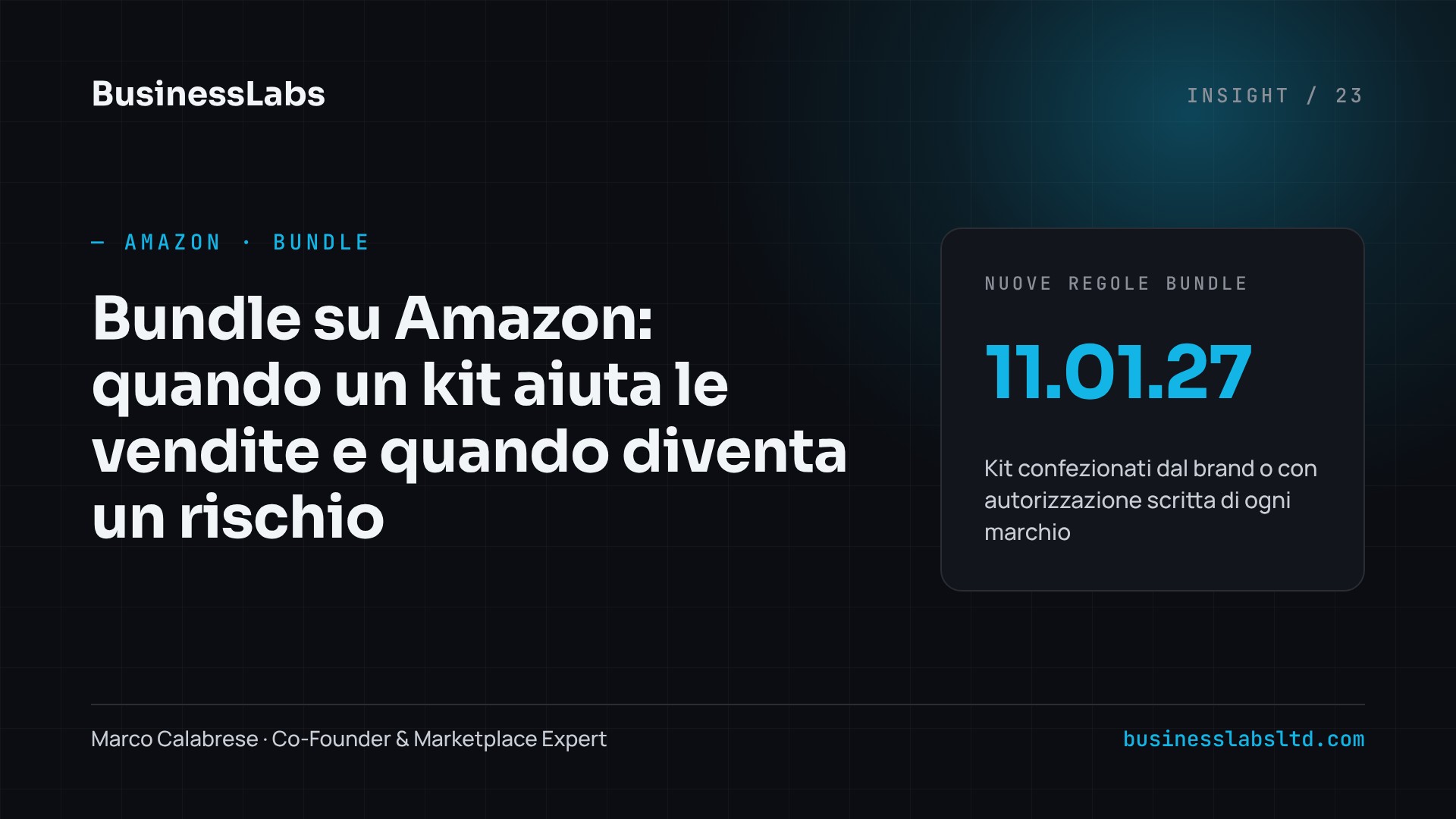
Amazon has told sellers that, from 11 January 2027, most bundles sold under a single ASIN will have to be packaged by the manufacturer or the original brand. The examples cited are the familiar seller-assembled kits: snack boxes, first-aid kits and gift sets containing different brands.
There are two ways to remain compliant: brand packaging, or a letter of authorisation from each brand included, to be uploaded in the Account Health section when the listing is flagged. Without these requirements, listings may be deactivated. Some exceptions remain outside the requirement, such as dedicated gift category nodes and virtual bundles.
The notice does not explicitly state which marketplaces are affected, and the previous version of the rule applied only to the US store. The practical advice is the same wherever you sell: take stock of your kits now and check in Seller Central what applies to each marketplace, before Amazon does it for you.
Virtual bundles: useful, but not everywhere
The virtual bundle is the most convenient tool for those with a brand in Brand Registry: you combine 2 to 5 complementary ASINs, all with active FBA inventory and in New condition, without creating a new code or repackaging anything. If one component runs out of stock, however, the whole bundle stops.
The main limitation for those selling in Europe is availability: according to Amazon's published guidance, the tool is available in the US store. Those working on Amazon.it, .de or .fr today need to focus primarily on physical bundles.
When a bundle really pays off
Before creating a kit, we always ask ourselves a few questions:
- Does it meet a genuine need? If the customer already buys the two products together, the kit makes purchasing easier. If we pair them only to clear slow-moving stock, it usually does not sell.
- Does the margin hold up? The kit's price must be compared with the sum of the individual items, after fees and the logistics cost of the new format, which may fall into a different size band.
- Do we have the right to do it? Our own brand, brand packaging or written authorisations: without one of these three elements, the kit is at risk.
- Can we manage the stock? A physical bundle is a new product to forecast, prepare and replenish, with its own sales history to build from scratch.
How we work on this
We treat a bundle as a product launch, not a shortcut. Before publication, we build the listing so that the kit's contents are clear from the main image, and we check requirements and authorisations. Afterwards, with Selleee, our software, we monitor component stock, because a kit missing one part stops selling.
If you are considering a kit for next year, now is the right time to set it up, before the new rules come into force. Start with a simple question: would I buy this bundle at the price I intend to sell it for?
Further reading: Amazon account management · FBA or FBM · Buy Box and repricing
Originally published on LinkedIn

Co-founder of BusinessLabs since 2023, he leads the marketplace area: strategy, launch and growth of Amazon accounts and expansion into foreign markets, from Europe to the Emirates and South America.
LinkedIn