In recent months more and more companies have been asking us the same thing: "We already cover Europe, can we try South America?". The answer almost always involves one name, Mercado Libre. Before opening an account, though, it is worth understanding how that market really works, because the rules are not Amazon's and mistakes are expensive.
Why people talk about Mercado Libre
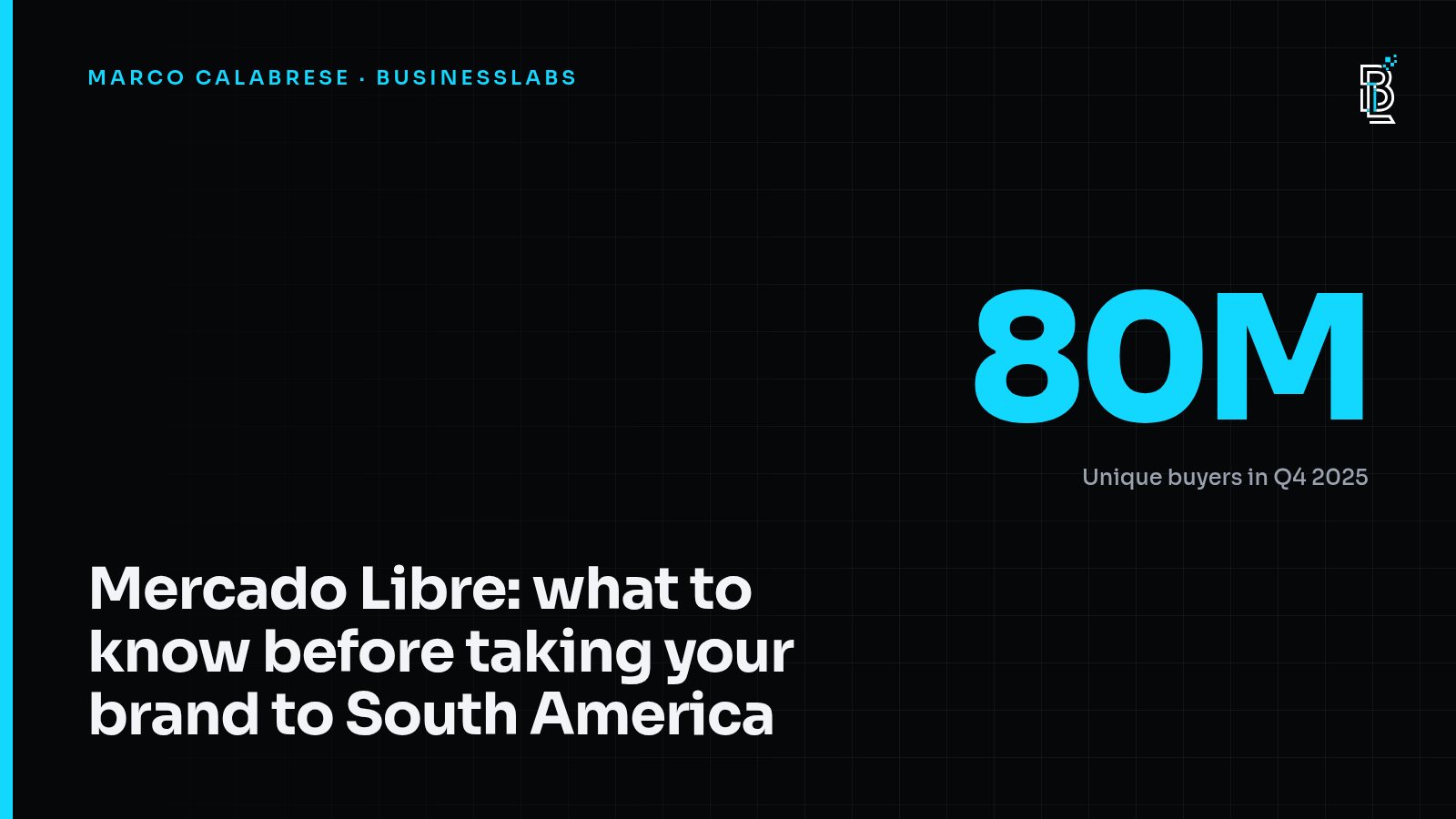
Mercado Libre is the leading marketplace in Latin America. In 2025 it closed with 28.9 billion dollars in net revenue, up 39%, and in the fourth quarter it exceeded 80 million unique buyers for the first time. The main markets are Brazil, Mexico and Argentina, followed by Chile and Colombia.
The point, for an Italian brand, is not the size in itself. It is that in many of these countries competition on European-quality products is still less crowded than on Amazon in Europe. That does not mean it is easy, though.
One country at a time, not "South America"
The first mistake we see is treating Latin America as a single market. It is not. Brazil speaks Portuguese, has one of the most complex tax systems in the world and prices that must be built taking duties and import taxes into account. Mexico has a very close trading relationship with the United States and more mature logistics. Chile and Colombia are smaller markets but often simpler to test.
That is why, when we work on an expansion plan, we choose a starting country based on three things:
- where the product already has verifiable demand (searches, competitors, price ranges);
- how much duties and taxes weigh on the final price;
- which logistics model is available in that country.
Global Selling or local presence
Mercado Libre offers a programme called Global Selling, which lets you sell in the main countries of the region without a local company, with payments in dollars. It is the quickest way to test a market, but it has constraints to check before starting: according to information published by the programme's partners, access today is mainly designed for companies registered in the United States, China or Hong Kong. An Italian company therefore has to assess whether to go through its own foreign entity, an authorised partner or, in the largest markets, a local presence.
A local presence costs more at the start (company, accounting, tax representation), but it gives access to all the marketplace's tools and makes prices, returns and customer service simpler. There is no absolute right choice: it depends on expected volumes and how much the brand wants to invest.
Logistics decides the margin
Here too there are two routes. With Mercado Libre's fulfilment (Mercado Envíos Full) the goods go into the marketplace's warehouses, which handle shipping and delivery. With direct shipping the seller keeps the stock and ships through the partner carriers. Fulfilment availability for foreign sellers varies from country to country, so it must be checked market by market.
The calculation we always do with clients is simple: selling price minus fees, international shipping, duties, local taxes, fulfilment costs, currency exchange and returns. If the margin only holds with an out-of-market price, it is better to know before shipping the first container.
What to prepare before opening the account
- Well-translated listings: Spanish and Brazilian Portuguese, not machine translations left as they are. Mexican Spanish is not the Spanish of Madrid.
- Product compliance: certifications, labels and registrations required in the destination country. The seller remains responsible for the legality of what they put on sale.
- Customs: goods held at customs do not come back on their own, because a new export procedure is needed. Documents and customs classifications must be sorted out beforehand.
- Payments and exchange: understand in which currency you are paid, how often and with what conversion costs.
- Customer service: response times and language matter here too for the account's reputation.
How we approach it at BusinessLabs
Our team works across three continents, and South America is one of the areas where we support companies. The approach is the same one we use for Europe: a 90-day plan with a single point of contact, which starts from the analysis of one country, checks the numbers and only then widens the scope. Andrea handles the listings, Dario the compliance side, and Giovanni keeps timelines and suppliers together.
The practical advice is this: before asking yourself whether to sell on Mercado Libre, choose a country, do the full margin calculation with duties and logistics, and check which account model is accessible to your company. If the numbers hold in one market, replicating them in the others becomes much simpler.
Further reading: Global expansion · Selling on Amazon in Europe
Originally published on LinkedIn

Co-founder of BusinessLabs since 2023, he leads the marketplace area: strategy, launch and growth of Amazon accounts and expansion into foreign markets, from Europe to the Emirates and South America.
LinkedIn