The first order imported from a non-EU supplier almost always costs more than expected. Not because of the unit price, which has usually been negotiated well, but because of everything that happens between the factory and the warehouse. When a client brings us a quote and asks whether the margin holds up, the first thing we look at is not the price: it is the three-letter code next to it.
The Incoterm decides who pays for what (and who carries the risk)
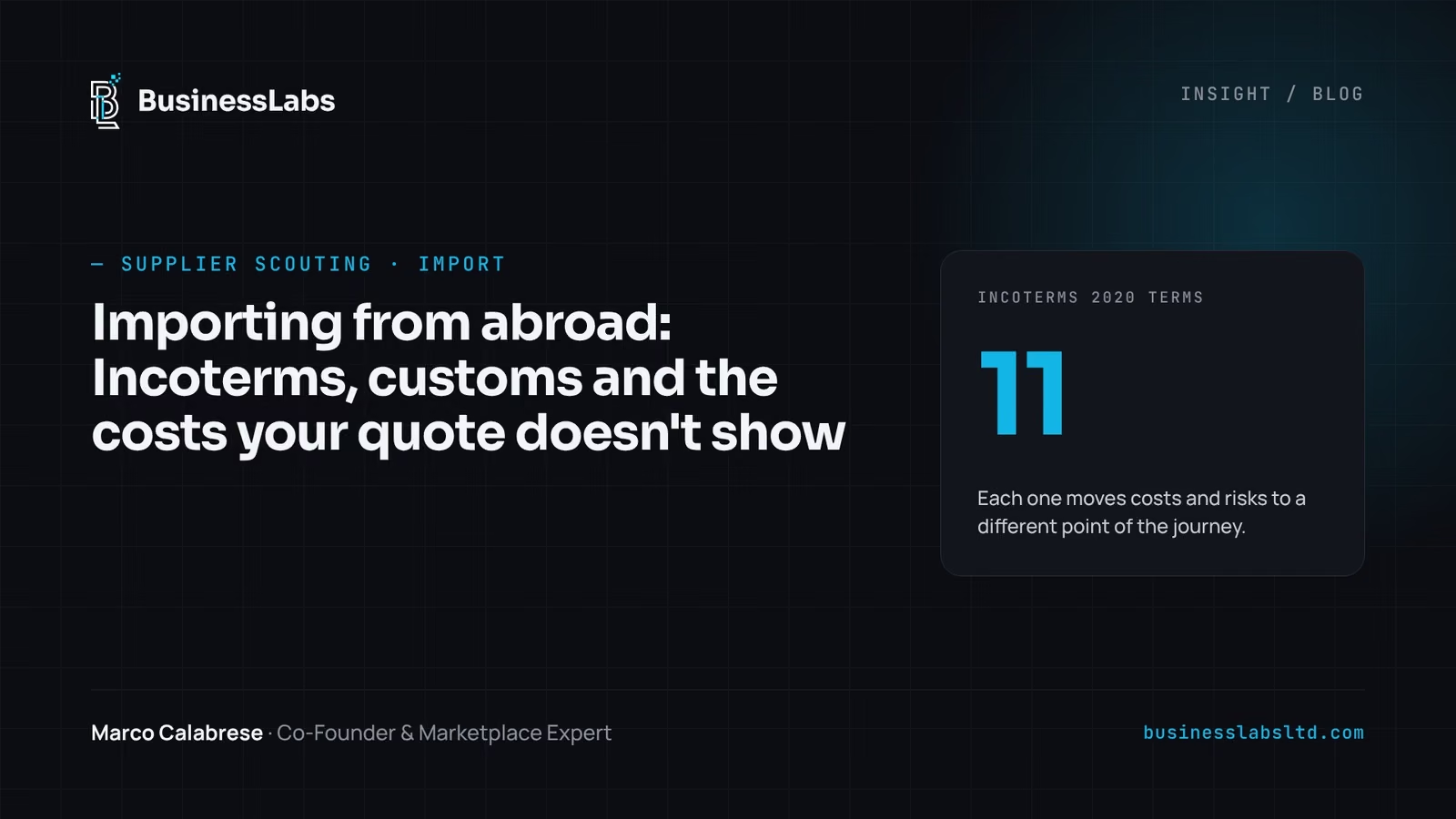
Incoterms are the rules published by the International Chamber of Commerce that set out, in a sales contract, where the seller's obligations end and the buyer's begin. The version in use is Incoterms 2020, which contains 11 terms. They do not govern price, payment or transfer of ownership: those stay in the contract.
The most common ones in the quotes we see are these:
- EXW (Ex Works): the supplier makes the goods available at its own premises. Everything else, including export customs clearance, is on you.
- FOB: the supplier clears the goods for export and loads them on board the vessel at the agreed port. The main carriage and the import are yours.
- CIF: the supplier pays freight and insurance to the port of destination, but the risk passes to you as soon as the goods are on board at the port of departure.
- DAP: the supplier delivers to the agreed place in your country. Import clearance, duties and VAT remain yours.
- DDP: the supplier takes care of everything, including duties and customs clearance in Italy.
FOB and CIF apply only to sea and inland waterway transport. Seeing them used for an air shipment is already a sign that the contract needs rereading.
Why a low EXW price can turn out to be the most expensive
An EXW price always looks the cheapest, because it includes almost nothing. The right comparison is the landed cost in your warehouse, not the price on the invoice. On top of the EXW price you need to add collection from the factory, export formalities, main carriage, insurance, unloading, customs clearance, duties, transport to the warehouse and the freight forwarder's fees.
DDP has the opposite problem: it is convenient, but the customs costs are hidden in the price and you cannot check them. And if something goes wrong at customs, you have few ways to find out what happened and how much it cost you.
In most cases we work with FOB and our own freight forwarder: the supplier does what it does best, which is producing and loading, and transport stays under the control of whoever has to sell the goods.
What you need to import into Italy
To import you need an EORI number, which identifies the operator in EU customs procedures. If the company already has one issued by another Member State, it is also valid for Italy.
Then there are two items to budget for from the start:
- Duties: they depend on the product's customs code and the origin of the goods. Two similar items can have different rates, so the classification must be checked before the order, not after.
- Import VAT: in Italy the standard rate is 22% and it is calculated on a base that includes the customs value, transport and insurance to the EU border, duties and ancillary costs up to the first destination in Italy.
Import VAT can be recovered, but it has to be paid up front: for a small business it is a cash-flow issue, especially on the first container.
What changed in 2026 for small parcels
Since 1 July 2026 the EU has applied a flat €3 duty on consignments worth up to €150 arriving from non-EU countries, mostly online purchases. It is calculated per customs category in the parcel, not per individual item.
For those who import in bulk and sell from Italy, little changes directly. What changes is the comparison with sellers who ship straight from Asia to the end consumer: a price advantage that used to be almost untouchable is now shrinking.
The sums to do before you sign
Before confirming an order with a new supplier, we build a sheet with the landed cost per unit:
- supplier price with the stated Incoterm;
- transport, insurance and customs clearance costs;
- duty calculated on the verified customs code;
- VAT to be paid up front and recovery times;
- transport to the warehouse or to the marketplace fulfilment centre.
Only on that figure does it make sense to calculate the margin and compare two suppliers. With our Supplier Scouting and Logistics services we handle this step together with the client, because a mistake on the Incoterm or the classification is paid for over the whole life of the product, not just on the first order.
If you are about to place your first order abroad, always ask the supplier for two quotes with different Incoterms. The comparison will tell you straight away how much control over the shipment is worth.
Further reading: Supplier Scouting service · Logistics service · FBA or FBM: who should ship your Amazon orders
Originally published on LinkedIn
Need help with shipping and logistics? See our e-commerce logistics service

Co-founder of BusinessLabs since 2023, he leads the marketplace area: strategy, launch and growth of Amazon accounts and expansion into foreign markets, from Europe to the Emirates and South America.
LinkedIn