
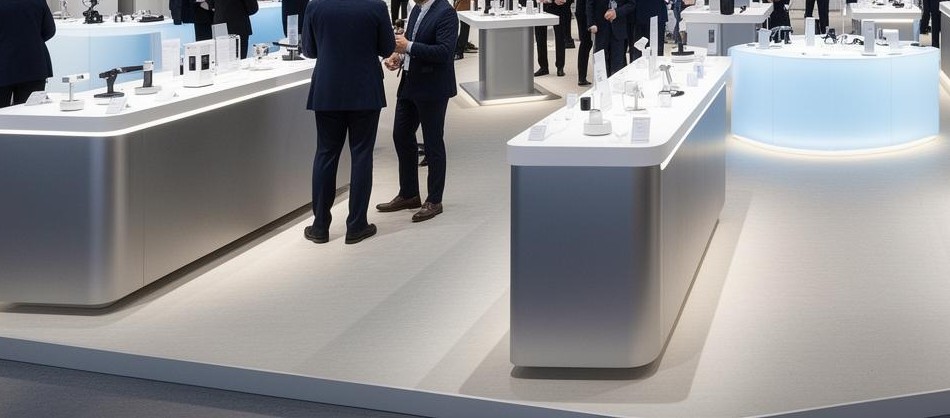
Berlin confirmed last year's predictions. The problem is what they say to anyone selling in Europe.
A year ago, writing my preview of IFA 2025, I pointed to three things worth watching: home robotics, mixed-reality headsets and glasses, and consumer energy. I added a note that seemed marginal at the time: watch the Chinese startups entering the European market. I came back from IFA 2026 with the three predictions confirmed and the marginal note turned into the main story of the show.
Numbers first. IFA 2026 closed with 240,000 visitors from 155 countries and more than 2,000 exhibitors: the largest edition ever. Of those exhibitors, 932 were Chinese companies, almost half the total and two hundred more than in 2025. Samsung left the exhibition grounds for the first time since 1991, taking a separate space in central Berlin dedicated to B2B meetings. Anker, which ten years ago sold chargers on Amazon, announced in Berlin the merger of its five brands under a single name and opened its first physical store anywhere in the world on Kurfürstendamm, with a 7 kWh home battery in the window.
Taken together, these three facts describe a show quite different from the one Europe thinks it is hosting.
What I predicted and what happened
Home robotics: confirmed, but not in the form I expected. The humanoids from Unitree, EngineAI, AGIBOT and Neura walked the catwalk and filled the stands of IFA Next, which grew to 300 exhibitors. They were spectacle, not product: none of the ones I saw will be on sale at a price a European consumer will pay in 2027. The real product was elsewhere: robot vacuums with mechanical arms, lawn mowers with no boundary wire, Hypershell's hiking exoskeletons that finally make sense for people with limited mobility. The home robotics that sells is the kind that does not look like a robot.
Mixed reality: half confirmed. AR glasses have entered handheld console bundles and every major brand's presentation, but they remain an accessory for enthusiasts. The headset as a mass category has not arrived, and I have stopped waiting for it.
Consumer energy: confirmed beyond my expectations, and this is the most interesting point for anyone who sells. Balcony batteries, plug-in solar and home storage were the most crowded category of the show: Anker, EcoFlow, Jackery and DJI presented products that plug into a household socket, install without a building site and promise to pay for themselves in two or three years. It is a category that exists almost only in Europe, because of German rules on balcony photovoltaics, and it is growing before European retail has understood it.
Chinese startups: here my prediction was wrong by understatement. Startups did not arrive. Industrial groups arrived, with distribution chains already in place, Chinese media partners officially accredited by the show, and a plan that goes beyond exporting product. Anker is the clearest case: unify the brands (eufy, soundcore, SOLIX) under one name, present a local AI hub that connects devices from different manufacturers, open a store of its own. That is not a supplier looking for a European distributor. That is a brand that wants to own the direct relationship with the European customer.
The show chose the consumer
There is a second change, less visible but just as important. IFA has become a festival. The Sommergarten with concerts late into the night, the creator stages, the children's area, the live podcasts. All legitimate, and 240,000 visitors say it works. But the signal that struck me is another one: Samsung's decision to move its B2B meetings out of the exhibition grounds. When the largest electronics exhibitor in the world decides the show is no longer where business is done, it is saying that the commercial value of the event has moved elsewhere. For an Italian buyer or distributor this changes how you go to Berlin: the show is for seeing, the deals are made in the hotels around it.
What it means for anyone selling in Europe
I ran companies for years that lived on electronics and appliance brands, and the lesson of IFA 2026 is uncomfortable: the brand pyramid has turned upside down. European appliance brands are restructuring, the Koreans are defending the premium end with AI, the Chinese have taken the middle and the bottom and are now moving up. For an Italian retailer or distributor this raises three questions that cannot be postponed.
First: what is a store for when the brand wants to sell direct? The Anker store in Berlin is an experiment, but the direction is clear. The retail that survives is the retail that adds something the brand cannot do alone: installation, service, comparison across brands, credit, trade-in. Retail that only displays boxes becomes a showroom paid for by the customer for a purchase that will happen elsewhere.
Second: who installs and services home energy? A balcony battery sells online, but a 7 kWh storage unit with 10 kW of solar input needs an electrician, a site visit, paperwork. It is exactly the kind of product that requires what a local retailer knows how to do and what a marketplace will never do. In my experience it is the category with the best ratio of service margin to online competition I have seen in ten years, and in Italy it is almost untouched.
Third: how much is trust worth in a regulated market? Local AI, data that stays at home, European certifications: every brand raised the theme, Chinese brands included. For anyone selling in Europe this is a real competitive advantage, provided you can explain it to the customer. A retailer who can say which product keeps data on the device and which sends it to a cloud outside the Union is selling something price cannot buy.
My criticism
Not of IFA, which did its job and did it well. Of us. Europe hosts the largest electronics show in the world and arrives without an industrial strategy for the sectors the show puts on display: consumer robotics, home energy, connected appliances. The European brands present were few and on the defensive. The Italian companies I met were almost all buyers, not exhibitors. Reading IFA as a showcase of products to import is the surest way to remain a destination market. This year Berlin showed that manufacturers have already decided to speak directly to our customers. It is up to us to decide what to put in between.
See you at IFA 2027. I will write my three predictions in January, and this time I will put the Chinese brands first.
Sources
- IFA Berlin, IFA 2026 closing statement: 240,000 visitors from 155 countries, more than 2,000 exhibitors.
- audioXpress, "IFA 2026 Berlin: A Compelling Opportunity" (September 2026): over 900 Chinese exhibitors, IFA Next at 300 exhibitors.
- BigGo Finance, "IFA 2026 Opens in Berlin" (September 2026): 932 Chinese exhibitors, Samsung's B2B space outside the fairgrounds.
- Anker Innovations, press release of 3 September 2026: brand unification, first store in Berlin, SOLIX Solarbank Max 7 kWh.
CEO & Co-Founder of BusinessLabs. I have attended major international trade shows since 2015 and share here experiences and insights for online sellers.
LinkedIn