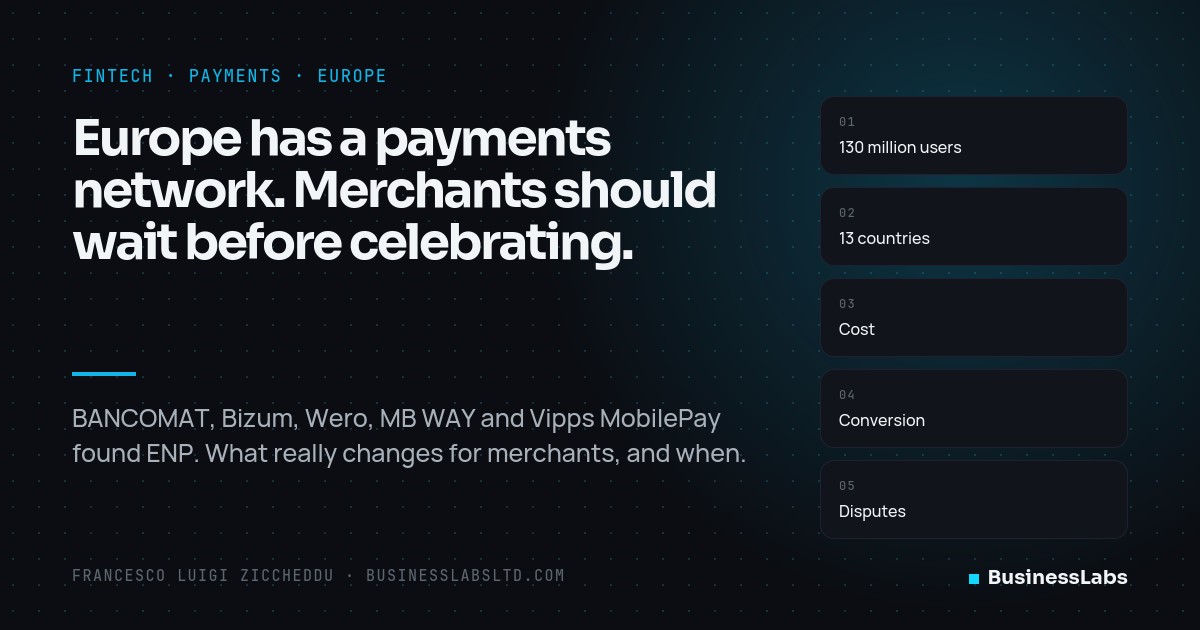
BANCOMAT, Bizum, Wero, MB WAY and Vipps MobilePay have founded ENP: 130 million users, a common hub, a European alternative to the American schemes. What actually changes for a company that sells, and when.
On 30 September 2026 five national payment systems set up a joint company in Madrid, the European Network for Payments. The shareholders, in equal parts, are BANCOMAT for Italy, Bizum for Spain, EPI Company with Wero for Belgium, France, Germany and the Netherlands, SIBS with MB WAY for Portugal, and Vipps MobilePay for Norway, Denmark and Finland. Together they count around 130 million users in 13 countries, more than 70% of the population of the European Union and Norway. ENP will run the technical and operational hub that connects these solutions, built on European standards and on instant account-to-account transfers.
It is significant news, and those who worked on it are right to be proud. For twenty years Europe has talked about a payment scheme of its own and produced acronyms, memoranda and a few failures. This time there is a company, a headquarters, a plan and, above all, a user base that already exists. But I read the news from the side where I work, the side of those who sell, and from there the picture is different. For an Italian retailer or e-commerce business, ENP changes nothing today. It will change a great deal, but not necessarily in the direction people expect.
What has actually been built
ENP is not a new app and not a new brand. It is the infrastructure that lets a Bizum user pay a BANCOMAT user, or an MB WAY customer pay in a store that accepts Wero, without either of them changing application. Each solution stays national in name, in experience and in its relationship with the bank. Interoperability sits underneath, invisible. It is a smart choice, because it avoids asking 130 million people to change a habit, and because national solutions carry a trust no pan-European brand could have built in under ten years.
The announced sequence is: person-to-person payments first, then physical stores, then online. Bizum, BANCOMAT and MB WAY had already connected private transfers between Spain, Italy, Portugal and Andorra in 2025. ENP extends that link to the other shareholders and brings it, on an undisclosed timeline, to commerce.
The problem it solves is not mine
ENP exists because of sovereignty. Today almost every card transaction in Europe runs through Visa or Mastercard, and a growing share of online payments through PayPal, Apple Pay and Google Pay. The ECB and the Commission have said for years that dependence on American infrastructure is a strategic risk, and they have said it with more urgency since trade tariffs became a foreign-policy instrument again. ENP is the European banking system's answer to that risk.
A merchant's problem is a different one. A merchant does not ask where the scheme is headquartered. A merchant asks three things: what does accepting this payment cost me, how many customers complete the purchase if I offer it, and what happens when something goes wrong. On all three ENP has not yet answered, and these are the three questions that will decide whether the project succeeds in commerce or remains an excellent way to split a restaurant bill.
Cost: the promise and the test
Account-to-account payment costs, in theory, far less than a card: no interchange fee, no scheme fee, no intermediary taking a percentage. In Europe interchange fees on consumer cards have been capped since 2015 at 0.2% for debit and 0.3% for credit, but the total cost to the merchant, with scheme and acquirer fees on top, remains noticeably higher, and for corporate or non-European cards much higher.
If ENP brings merchants an acceptance cost that is consistently below cards, it will have won. But that is not automatic. The national solutions are owned by banks, and banks earn money from cards. The temptation to price the new channel just below the old one, rather than at its real cost, is strong and has been seen before. The first thing a company should ask its PSP, when the offer arrives, is a per-transaction cost comparison, not an introductory discount.
Conversion: the button that is not there
Online, a payment method is worth the number of customers who use it at the moment they have to pay. PayPal and Apple Pay convert because they are everywhere, recognisable and two taps away. An Italian e-commerce business selling in Spain cannot put a Bizum button at checkout today, and after ENP it will only be able to once the commercial phase is live and its gateway has integrated it. In the meantime, the question a merchant will ask is: the same Spanish customer who has Bizum also has a card and PayPal, so why should I add one more method?
The answer exists, but it has to be built: instant account-to-account payment is the only method that eliminates card fraud risk and makes funds available immediately. For a retailer with thin margins and tight cash flow, that is a concrete advantage. But only if the checkout presents it well, if the PSP reconciles it like every other method and if the customer recognises it. The interoperability work is done. The acceptance work is entirely ahead, and it belongs to PSPs, gateways and e-commerce platforms, not to ENP.
What happens when something goes wrong
This is the point no press release touched. With a card there is the chargeback: the customer disputes, the scheme arbitrates, the merchant sometimes loses. It is costly and often unfair, but it is a protection system consumers know. With an instant transfer the money has moved and does not come back, unless agreed. For the merchant that is a relief. For the consumer it is a leap into the void, and regulators will not allow it for long without some form of protection.
How ENP and the national solutions design dispute handling, refunds and buyer protection will decide whether the system is adopted in online commerce, where returns and disputes are part of the business model. It is the most technical and least visible theme of the whole project, and the one worth the most.
What to do now, if you sell
Nothing urgent, three sensible things. First: if you have physical stores in Italy, check that your POS already accepts BANCOMAT Pay, because it will be the entry point of the new system and many terminals still do not handle it. Second: ask your PSP what the plan is for account-to-account payments and Wero, and demand dates, not intentions. Third: look at your checkout data by country and method. If you sell in Spain, Portugal or France, you will know what it is worth to you the day a customer can pay with the app they use every day.
ENP is a piece of infrastructure, and infrastructure is what Europe has lacked for twenty years. But infrastructure is not a product. The product, for those who sell, will be made of price, button and dispute rules. That is where the real game is played, and it starts now.
Sources
- Joint shareholder statement, 30 September 2026 (EPI Company, KBC): incorporation of ENP, shareholders, Madrid headquarters, interoperability hub, 130 million users in 13 countries, over 70% of the EU and Norway population.
- ANSA, 30 September 2026: P2P, in-store, online sequence; national brands and experiences retained.
- Marketing4eCommerce, 30 September 2026: Bizum, BANCOMAT and MB WAY interoperability since 2025; EuroPA alliance and EPI.
- Regulation (EU) 2015/751 on interchange fees: caps of 0.2% for debit and 0.3% for credit.

CEO & Co-Founder of BusinessLabs. I have attended major international trade shows since 2015 and share here experiences and insights for online sellers.
LinkedIn